
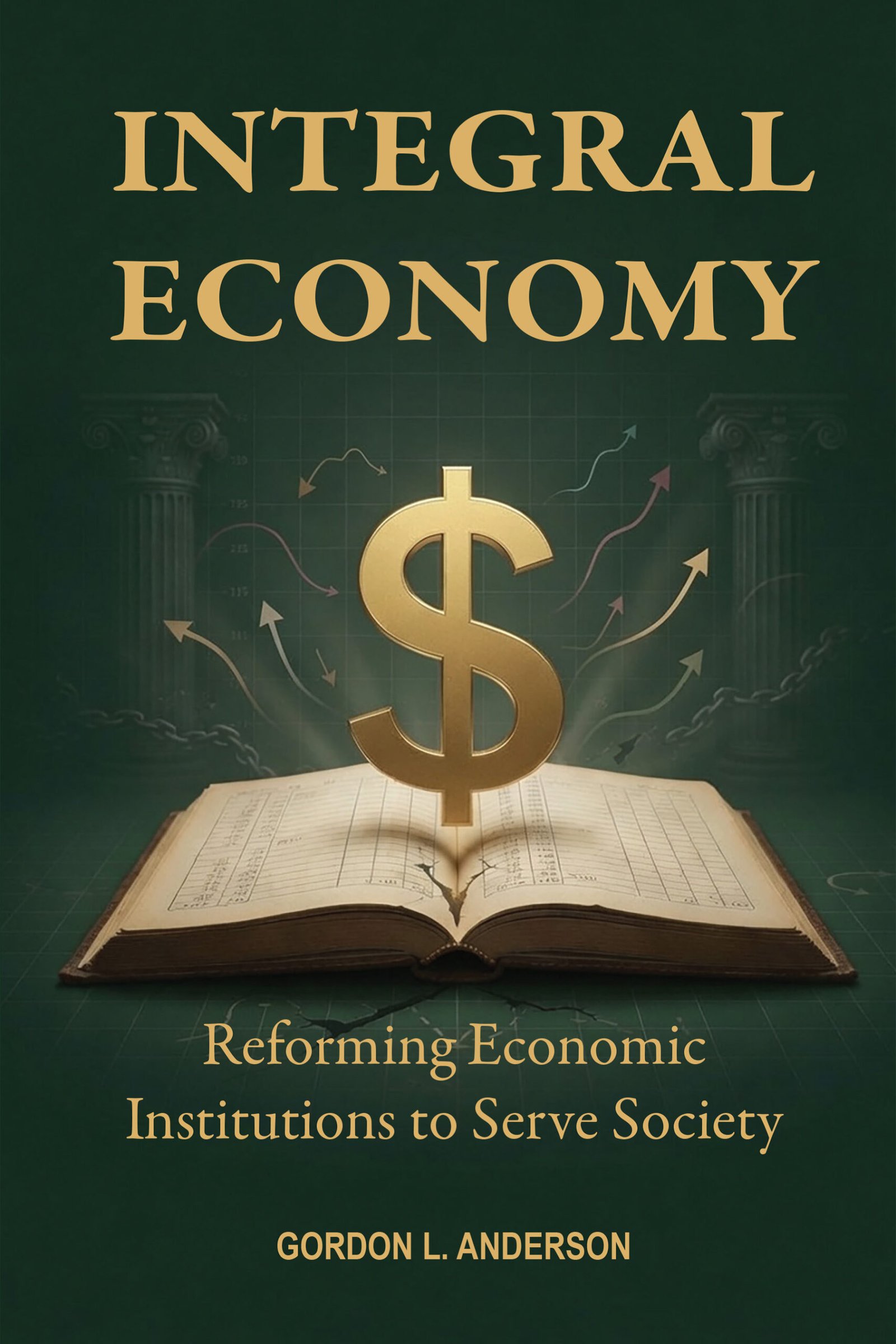

Description
Afflicted by political corruption, economic chaos, and cultural calamity, “We the People of the United States” need new visions for a better future 250 years after the nation’s founding. Gordon Anderson’s Integral Economy takes significant steps in that direction. Brimming with challenging ideas and inviting vigorous debate, this compact book will help Americans to discern the best ways forward. —John K. Roth, Edward J. Sexton Professor Emeritus of Philosophy, Claremont McKenna College. Author, Saving the American Dream: Meditations for Dark Times In Integral Economy: Reforming Economic Institutions to Serve Society, Gordon Anderson presents a bold vision for transforming the present U.S. centralized economy into a decentralized system. For readers willing to consider alternative economic approaches that preserve freedom while potentially increasing fairness, Integral Economy offers food for thought. The ultimate value of this book may be its insistence that we ask larger questions about the quality of our society’s economic relations. —Steve McIntosh, author of Truth Emerging: A Developmental Philosophy of Purpose and Progress The giants in economic theory, from Aristotle to Adam Smith and Friedrich A. Hayek, have recognized that personal happiness and social stability require the wide ownership of private property by socially responsible individuals. Money, banks, and other institutions that can serve economies are repeatedly captured by elites and centralizers. Kings, mercantilists, central bankers, communists, and globalists at the World Economic Forum seek central control of economies, accumulating vast wealth for themselves, while allowing just enough for the working masses to live. The rise of modern industry and the production of goods through machinery added income from capital ownership to income from one’s labor. A labor theory of value must be supplemented by a capital theory of value in this binary economy. This was first articulated by Louis Kelso and Mortimer Alder in the Capitalist Manifesto (1957). Today, capital ownership remains centrally controlled. The Protestant Reformation of the economy is about a transformation that provides an opportunity for everyone to earn income from the ownership of capital. An integral economy distributes capital ownership widely by reforming banking, taxation, the patent system, and capital income accounts provided to everyone at birth.
Download and share this book flyer.
YouTube Presentation on the Ethical Framework, Aug 1, 2026
YouTube Presentation on the Need for Reforming Economic Institutions, Sept. 25, 2026


Reviews
There are no reviews yet.