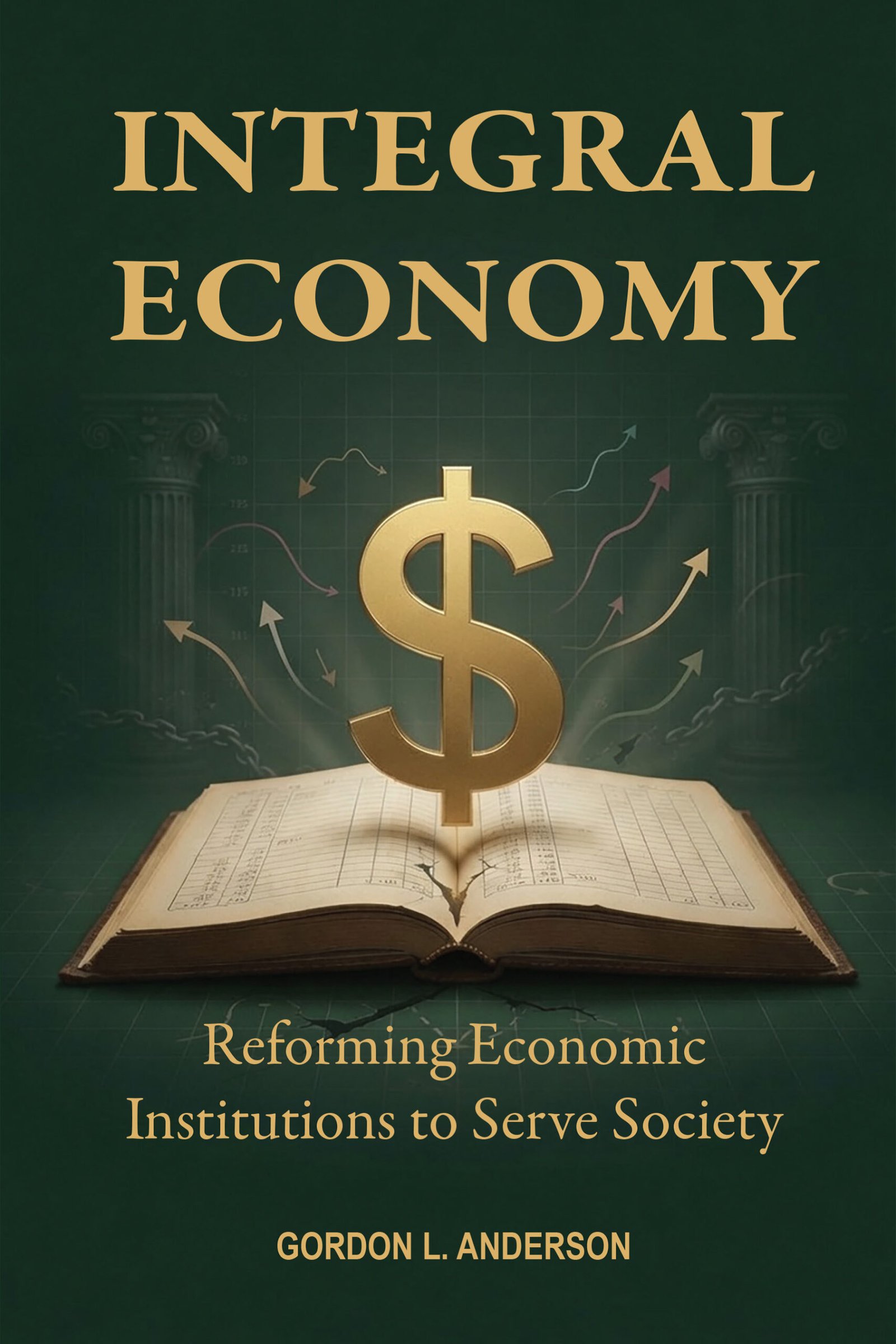
Integral Economy: Reforming Economic Institutions to Serve Society

$24.95

Today, capital ownership remains centrally controlled. The Protestant Reformation of the economy is about a transformation that provides an opportunity for everyone to earn income from the ownership of capital. An integral economy distributes capital ownership widely by reforming banking, taxation, the patent system, and through capital income accounts provided to everyone at birth.

Economically responsible individuals are nourished by personal institutions on the right wing of society and an ethical economic playing field by impersonal ethical institutions on the left wing. Both wings serve the head, which contains the collective wisdom of society.

The book covers money, banking, binary economics, corporations, taxes, capital distribution, and an economic path upward for everyone. It is complete with appendices that contain five bills ready to make the U.S. Economy integral: (1) Decentralized Banking and Currency Stability Act; (2) Shareholder Dividend and Corporate Tax Reform Act; (3) Patent Reform and Public Access Act; (4) Youth Civil Service and Economic Autonomy Act; and (5) Capital Income Act.

Out of stock

Description

Afflicted by political corruption, economic chaos, and cultural calamity, “We the People of the United States” need new visions for a better future 250 years after the nation’s founding. Gordon Anderson’s Integral Economy takes significant steps in that direction. Brimming with challenging ideas and inviting vigorous debate, this compact book will help Americans to discern the best ways forward.
John K. Roth, Edward J. Sexton Professor Emeritus of Philosophy, Claremont McKenna College. Author, Saving the American Dream: Meditations for Dark Times

In Integral Economy: Reforming Economic Institutions to Serve Society, Gordon Anderson presents a bold vision for transforming the present U.S. centralized economy into a decentralized system. For readers willing to consider alternative economic approaches that preserve freedom while potentially increasing fairness, Integral Economy offers food for thought. The ultimate value of this book may be its insistence that we ask larger questions about the quality of our society’s economic relations.
—Steve McIntosh, author of Truth Emerging: A Developmental Philosophy of Purpose and Progress

The giants in economic theory, from Aristotle to Adam Smith and Friedrich A. Hayek, have recognized that personal happiness and social stability require the wide ownership of private property by socially responsible individuals. Money, banks, and other institutions that can serve economies are repeatedly captured by elites and centralizers. Kings, mercantilists, central bankers, communists, and globalists at the World Economic Forum seek central control of economies, accumulating vast wealth for themselves, while allowing just enough for the working masses to live.

The rise of modern industry and the production of goods through machinery added income from capital ownership to income from one’s labor. A labor theory of value must be supplemented by a capital theory of value in this binary economy. This was first articulated by Louis Kelso and Mortimer Alder in the Capitalist Manifesto (1957).

Today, capital ownership remains centrally controlled. The Protestant Reformation of the economy is about a transformation that provides an opportunity for everyone to earn income from the ownership of capital. An integral economy distributes capital ownership widely by reforming banking, taxation, the patent system, and capital income accounts provided to everyone at birth.

Additional information

Weight 1.5 lbs
Dimensions 9 × 6 × 1 in
E-Book ISBN

9781610831352

Release Date

September 15, 2026

Author

Anderson, Gordon L.

Gordon L. Anderson earned his Ph.D. in Philosophy of Religion at the Claremont Graduate University. He has been editor-in-chief of International Journal on World Peace since 1992. He is author of many articles and books, including Philosophy of the United States: Life, Liberty, and the Pursuit of Happiness (2004) and Life, Liberty, and the Pursuit of Happiness, Version 4.0 (2009). Anderson has a long experience with the analysis of major political systems. In 1985, he organized with Professors Alexander Shtromas, Morton A. Kaplan and 90 sovietologists, in Geneva, Switzerland, a conference on "The Fall of the Soviet Empire: Prospects for Transition to a Post-Soviet World." Observers later stated that this conference not only accurately predicted the end of the Soviet Union, but may have helped guide its peaceful transition. In 1987, in the Philippines, with the guidance of Professors Ilpyong J. Kim and Morton A. Kaplan, a similar study with 90 sinologists was conducted on "China in a New Era: Challenges and Opportunities." Then in 1989, in London, England, with the guidance of Professor Edwards Shils he organized a conference of 90 experts on democratic government titled "Liberal Democratic Societies: The Present State and Future Prospects." He edited Morality and Religion in Liberal Democratic Societies, one of the seven books published from this conference. Anderson also serves as President of the Minnesota Legislative Evaluation Assembly, of which he has been a member evaluating the Minnesota legislature since 1999.
Author's Website: http://blog.ganderson.us

Reviews

There are no reviews yet.

Be the first to review “Integral Economy: Reforming Economic Institutions to Serve Society”

Your email address will not be published. Required fields are marked *